Public Web · RELEASED
Server-side analysis at studio.vonmallinckrodt.com for examples, teaching, public data, or data deliberately submitted for processing.
Open Studio Web ↗Published journal article
The AIP Advances article derives, for a defined class of nearly unstable linear stochastic systems, why the stationary covariance spectrum concentrates as a fold bifurcation is approached. Under assumptions A1–A4, the dominant covariance eigenvalue diverges while the remaining eigenvalues stay bounded, implying Φ(Σ) → 1.
Scope: mechanism-specific, not universal; the paper explicitly excludes defective eigenvalue structures, unexcited critical modes, high-dimensional bulk dominance, and exogenous shock dynamics.
Research software · Open science
BenchEWS Studio is available through two public access paths: directly in the browser as Studio Web and locally as the released macOS DMG. Both access paths remain subject to the same documented scientific status and evidence boundaries.
First launch on macOS: Studio 2.0.0 is distributed as ad-hoc-signed scientific software and is not Apple-notarized. If macOS blocks the first launch, use System Settings → Privacy & Security → Open Anyway, then confirm Open. Do not disable Gatekeeper globally.
ENTRÉE / STUDIO 2.0.0
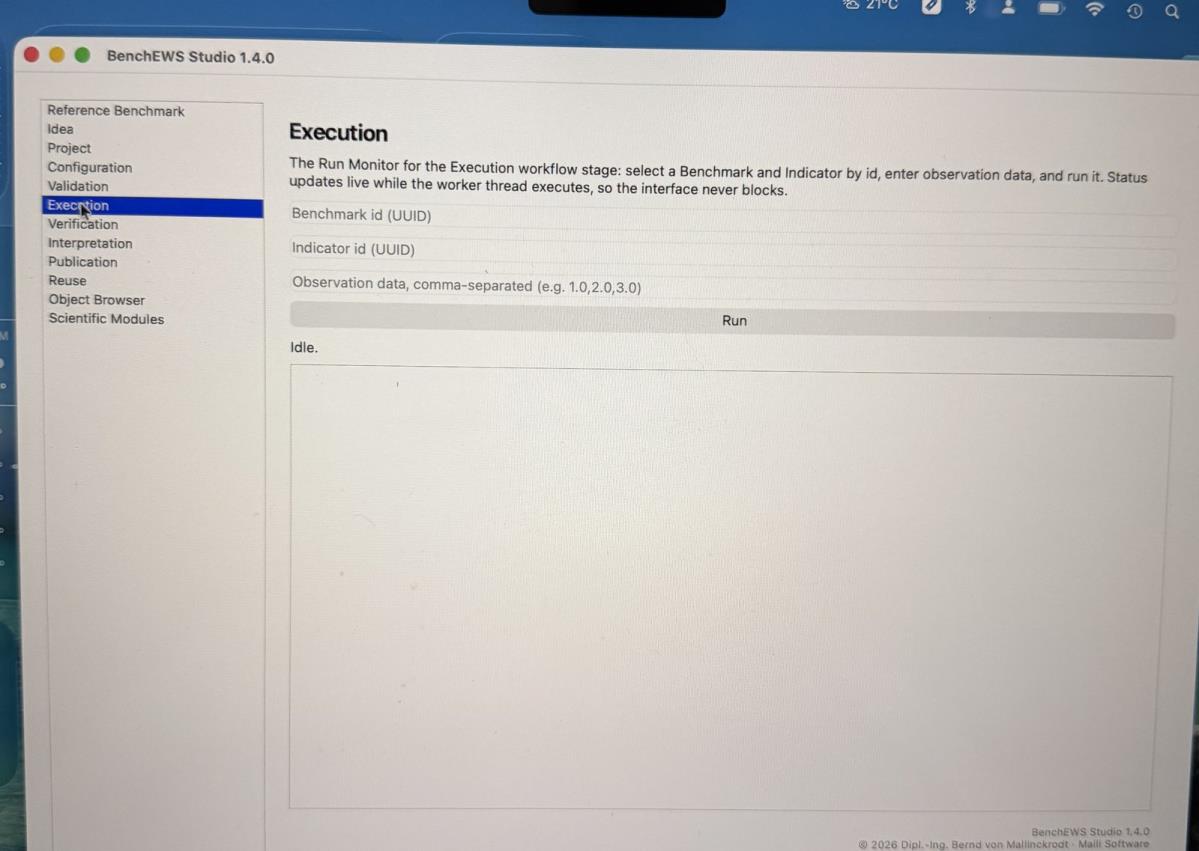
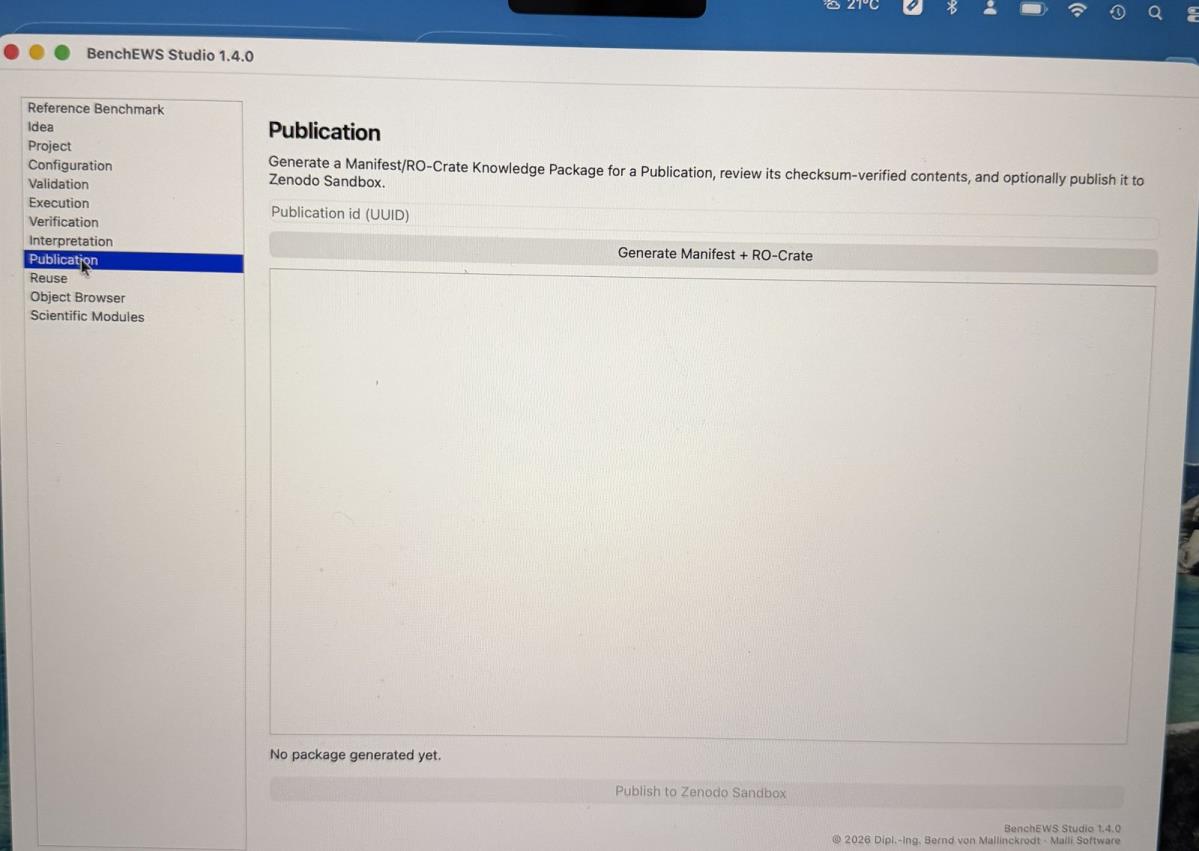
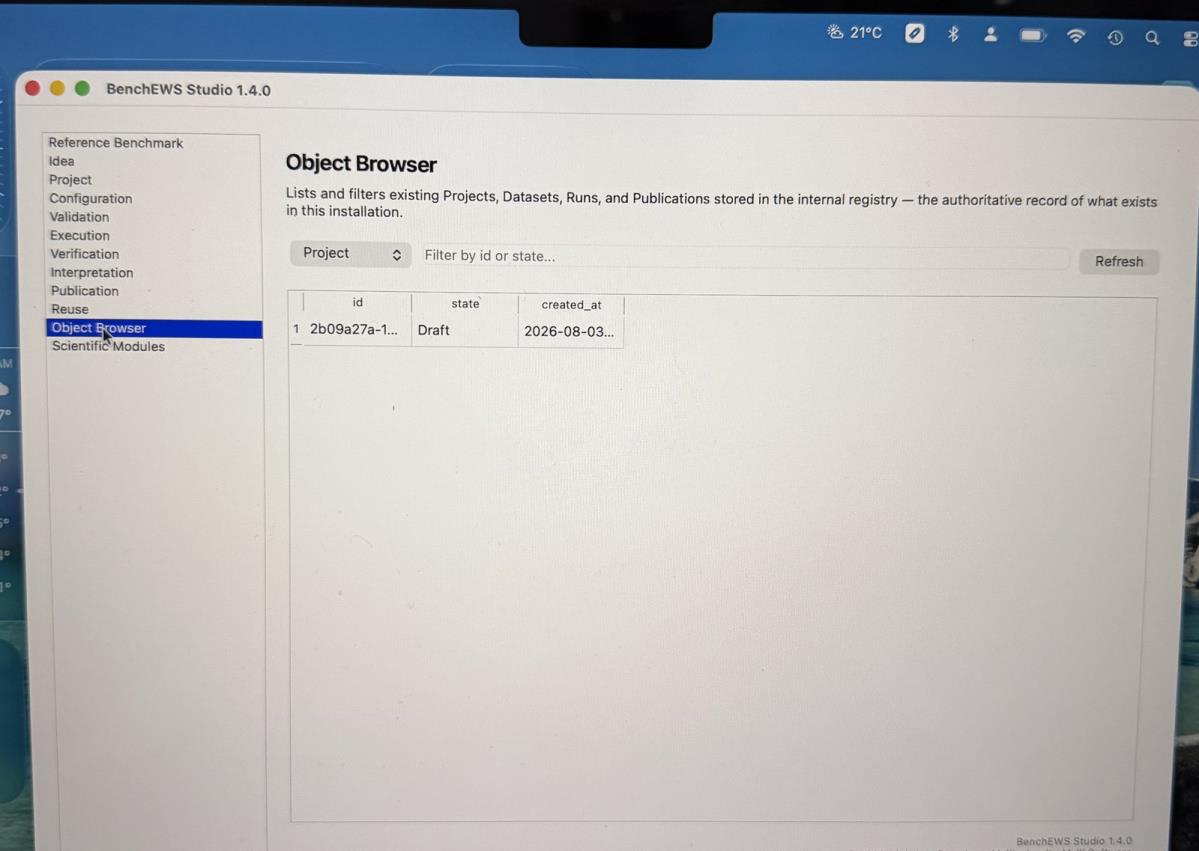
The screenshots previously shown here belonged to historical version 1.4.0 and have therefore been removed from the 2.0.0 entrée. For the current interface, only the documented 2.0.0 release is authoritative; the illustrated User Manual provides the visual walkthrough of the released software.
STUDIO WEB / DATA CUSTODY
The Web version is already available. A local Linux offline ZIP is being prepared. The download link will appear once the final file, checksum and license notices are ready.
Server-side analysis at studio.vonmallinckrodt.com for examples, teaching, public data, or data deliberately submitted for processing.
Open Studio Web ↗Run analyses locally on your own computer. The ZIP and a short quick-start guide will be linked here once the package is verified.
For confidential research data, use a computer disconnected from external networks. The offline application is not a secured network server.
Software · Release status
Released: 24 September 2026
Current public release · Zenodo DOI 10.5281/zenodo.22928826Planned for mid-2027
Development horizon · next stage of evidence-based system diagnostics01 / Historical release
The versioned Zenodo record provides the software, macOS DMG, user manual, and release documentation. The graphical environment connects idea, project, configuration, validation, execution, verification, interpretation, publication, reuse, registry inspection, and focused module analysis across twelve task-oriented panels.
Population variance and lag-1 autocorrelation for univariate observation series.
The built-in 20-point series must reproduce variance 0.8310 and lag-1 autocorrelation 0.7753.
A guarded ten-state workflow, append-only audit trail, SQLite registry, and SHA-256-addressed artifacts preserve traceability.
Results are indicative. Version 1.4.0 does not estimate self-correction capacity, quantify measurement uncertainty, or predict tipping points automatically.
02 / The 12-panel scientific workflow
This list follows the final Studio 2.0 navigation. Dataset, Simulation, Algorithm, Visualization, Report, and Export may name analysis objects or functions, but they are not additional current navigation panels.
PurposeRuns the fixed Scientific Reference Benchmark as an installation and computation check.
Scientific benefitDocumented target values show whether the verified core computation is reproducible.
Studio 2.0 todayStudio 2.0 includes four EWS in its analytical scope: variance, lag-1 autocorrelation, skewness, and CRTI. The fixed Reference Benchmark currently checks variance and lag-1 autocorrelation against documented target values; skewness and CRTI remain clearly identified as the other Studio 2.0 indicators.
Explicit boundaryLimiting the fixed target-value check to two measures does not mean that Studio 2.0 contains only two EWS. The benchmark is also not a general best-EWS selection system and is not an analysis of an unknown real-world system.
Studio 3.0 / ECHO · PLANNEDStudio 3.0 / ECHO is planned to extend standardized comparison with transparent evidence-based assessment and recommendation support.
PurposeRecords the research question, hypothesis, or motivation as an explicit starting point.
Scientific benefitThe conceptual origin of the study remains traceable within the project context.
Studio 2.0 todayA scientific idea can be created and persisted for subsequent workflow objects.
Explicit boundaryFormulating an idea produces neither evidence nor hypothesis validation.
PurposeTurns an idea into an organizational container for a study.
Scientific benefitRelated configurations, runs, and results receive a reproducible project context.
Studio 2.0 todayProjects can be created, identified, and maintained in the registered object inventory.
Explicit boundaryA project or workflow status is not a statement of scientific quality or validation.
PurposeAssembles a benchmark configuration from existing registered analysis objects.
Scientific benefitInputs and analytical conditions are specified explicitly and traceably.
Studio 2.0 todayExisting Scenario, Dataset, Observation Strategy, and Indicator objects can be combined into a configuration.
Explicit boundaryThe software does not automatically guarantee that the selected configuration or parameterization is scientifically optimal.
PurposeChecks schema and cross-object consistency for a configuration.
Scientific benefitFormal inconsistencies can be identified before execution.
Studio 2.0 todayInternal rules determine whether the registered objects are technically executable together.
Explicit boundaryThis is software and object validation, not empirical or scientific validation of a hypothesis.
PurposeExecutes an approved run with the selected data and method.
Scientific benefitThe computation and workflow state are produced in a controlled, traceable manner.
Studio 2.0 todayA valid configuration can be executed and its run state documented.
Explicit boundarySuccessful execution is neither scientific interpretation nor evidence of predictive superiority.
PurposeSupports technical integrity and reproducibility checks for a run.
Scientific benefitThe result, configuration, provenance, and state sequence can be checked against one another.
Studio 2.0 todayThe technical traceability of a completed run is checked through the available verification paths.
Explicit boundaryTechnical verification proves neither the scientific correctness of the method nor the meaning of the result.
PurposePresents results for scientific assessment by the user.
Scientific benefitObservations and conclusions can be documented in the context of the research question.
Studio 2.0 todayResults are made available for review and user-led interpretation.
Explicit boundaryStudio 2.0 does not generate autonomous scientific truth or select the correct interpretation by itself.
Studio 3.0 / ECHO · PLANNEDECHO is planned to offer transparently justified decision support; scientific responsibility remains with the researcher.
PurposePrepares the manifest, RO-Crate, and publication object within the implemented workflow.
Scientific benefitResults, configuration, and provenance can be assembled into an inspectable research artifact.
Studio 2.0 todayA Knowledge Package can be prepared and made ready for a deliberate publication step.
Explicit boundaryPackage generation is not actual publication, peer review, or scientific validation.
PurposeSupports discovery and reuse of existing publication and research objects.
Scientific benefitPrior work can be used traceably for re-execution, reproduction, or replication contexts.
Studio 2.0 todaySuitable registered objects can be selected for a subsequent research workflow.
Explicit boundaryReuse guarantees neither reproducibility on external infrastructure nor successful independent replication.
PurposeLists and filters registered Projects, Datasets, Runs, and Publications.
Scientific benefitResearchers can see which objects actually exist in the local registry.
Studio 2.0 todayObject type, identity, state, and creation time can be searched and inspected.
Explicit boundaryThe Object Browser does not assess scientific quality or strength of evidence.
PurposeApplies one selected Scientific Module to observation data for focused analysis.
Scientific benefitA particular mathematical detector can be examined directly instead of only appearing within a broader workflow.
Studio 2.0 todayThe verified 2.0 baseline executes variance, lag-1 autocorrelation, skewness, and CRTI. CRTI uses the multivariate algorithm binding and is an assumption-bound spectral compression/recovery research module.
Explicit boundaryThe result answers what this selected EWS shows for these data - not whether it is the best EWS for the dataset.
Studio 3.0 / ECHO · PLANNEDECHO is planned to connect individual results with comparative evidence and defined evaluation criteria.
What does this selected EWS show for the current dataset?
Does the installation reproduce the documented target values for the fixed reference series?
Which EWS or combination provides the strongest evidence under defined criteria - or is no reliable recommendation possible?
Implementation boundary: Studio 2.0 performs calculation and structures evidence for assessment. General method selection and scientific interpretation remain the responsibility of the researcher.
03 / Expectation management
What is mathematically computed?
What can be observed, checked, compared, and documented?
What conclusion is justified, and who makes it?
Studio 2.0 performs calculation and structures evidence for assessment. Scientific interpretation and general method selection remain the responsibility of the researcher.
04 / Current software release
The current BenchEWS reference software is published on Zenodo as a versioned open-science artifact. Studio 2.0.0 combines the twelve-panel scientific workflow with four registered analytical methods: variance, lag-1 autocorrelation, skewness, and CRTI. Software verification and scientific validation remain explicitly separate layers.
The 2.0.0 distribution is not Apple-notarized. If macOS blocks the first launch, open System Settings → Privacy & Security → Open Anyway, then confirm Open. Do not disable Gatekeeper globally and do not use xattr, chmod, or quarantine-removal workarounds.
The core workflow requires no telemetry and no background uploads. Users remain responsible for the legal and ethical handling of research data they load or export.
Installation, first launch, Reference Benchmark, all twelve panels, Scientific Modules, reproducibility, and troubleshooting.
Download User Manual ↓Architecture, epistemic status, CRTI, scientific boundaries, provenance, and interpretation.
Download Scientific Release Companion ↓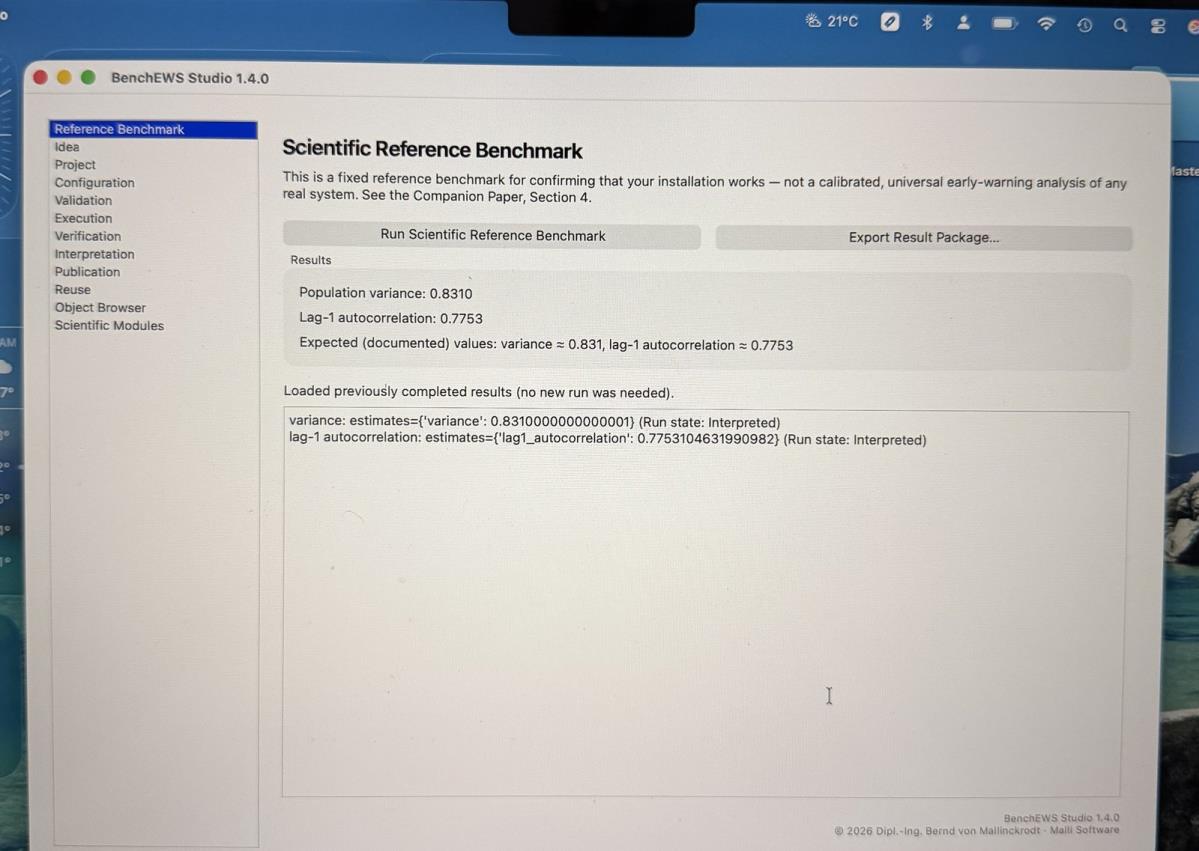
Scientific boundary: A successful software run is not universal evidence of an approaching tipping point. Results remain conditional on data quality, model assumptions, observation channels, and domain-specific evidence.
05 / Research and implementation horizon
The planned architecture would connect domain packs, Scientist Mode, Guided Research Mode, an AI-assisted evidence layer, and a broader portfolio of explicitly registered early-warning methods. Every capability remains subject to operationalization, verification, reproducibility, and empirical testing.
Planned transparent, validation-aware assessment by warning lead time, detection latency, robustness, noise sensitivity, parameter stability, false-alarm behavior, temporal consistency, uncertainty, indicator agreement, and - where available - ground truth and justified out-of-sample performance.
Preferred single EWS · Complementary multi-EWS evidence · NO_RELIABLE_RECOMMENDATION / INDETERMINATE. Every statement remains conditional on the dataset, criteria, validation information, and uncertainty.
Falsifiable framework for adaptive evidence integration, prediction-error persistence, estimator latency, and candidate behavioral lock-in. No empirical data and no diagnostic function.
Open versioned paper ↗Network-scale framework for epistemic quality, visibility, propagation, lock-in, and candidate reopening of correction pathways.
Open versioned paper ↗Operationalization → experimental design → parameter recovery → estimator-latency tests → competing-model analysis → reproducible implementation → possible later validation.
Studio 3.0 is a research horizon, not a released product or an empirically validated diagnostic instrument. Mid-2027 is the current target horizon, not a binding release date.
Ground-truth boundary: Without known ground truth, ECHO may compare properties and strength of evidence under defined criteria, but it cannot prove objectively superior real predictive performance. Evidence ranking ≠ validated predictive superiority.
Status: ECHO is planned to support scientific decisions, not replace scientific judgment.
Canonical source: Schedule, target horizons, and planned development stages are maintained only on the research roadmap. This software page documents implementation scope and evidence boundaries.
Primärquellen / Further reading
Versionierte Primärquellen aus dem BenchEWS-Forschungsprogramm – ausgewählt für den Gegenstand dieses Kapitels.
Current released software with User Manual, Scientific Release Companion, and documented release verification.
10.5281/zenodo.22928826↗Historical softwareHistorical reference release, superseded by Studio 2.0.0 as the current public version.
10.5281/zenodo.21807143↗Published theoryTheoretical hypothesis and methods framework; no empirical data.
10.5281/zenodo.22477244↗Published hypothesis frameworkNetworked information systems and candidate adaptive reopening.
10.5281/zenodo.22343273↗06 / Canonical research target
BenchEWS is the research program. BenchEWS Studio is the instrument used to operationalize, examine, and visualize parts of this mathematical detection framework. The self-correction architecture is not a retroactively implemented Studio 2.0 capability, but an operational research path for later, explicitly verified releases.
Open the self-correction framework →