Too little viable structure
Many possible movements, but too little coherent organisation for reliable correction.
OPEN RESEARCH PROGRAMME · OPEN SCIENCE
Mathematical system detector for the loss and recovery of self-correction
BenchEWS investigates under which conditions complex adaptive systems lose their capacity for self-correction — and how that capacity can be recovered. An independent research programme by Bernd von Mallinckrodt.
BenchEWS investigates whether complex adaptive systems lose measurable structural degrees of freedom before conventional state-based warning signals rise clearly. The programme combines mathematical indicators, falsification criteria, simulation, and open-science software.
00A / LATEST ZENODO PUBLICATION
The newest Zenodo record in the author portfolio is synchronized automatically from the publication feed. Editorial topic placement remains curated.
Read the original abstract and methodological scope in the linked Zenodo record.
01 / UNDERSTAND FIRST
Variance, excursions, or other conventional warning signals may become obvious only late.
Functionally available degrees of freedom and effective feedback may decline beforehand.
Move the slider toward rigidity: the conventional stability signal can remain high while self-correction has already begun to fall.
Can that structural loss be measured earlier and reproducibly?
02 / MEASUREMENT IDEA
Too little structure can create instability. Too much fixation can constrain feedback, responsiveness, and adaptive degrees of freedom. BenchEWS studies this balance without assuming one universal causal chain.
03 / READING PATHWAYS
The Research Map paper is the canonical entry point to the architecture, evidence boundaries, and open-science resources.
04 / METAPHORS & MENTAL MODELS
BenchEWS uses metaphors as entry points, not as claims that different systems obey identical physical mechanisms. They make three structural questions intuitive before the mathematics begins: Where can a system return? When does a threshold alter feedback? When does more input stop producing a proportional response?

Gömböc points to return geometry and accessible states; Leidenfrost to threshold-driven decoupling and possible reopening; Schwarzschild reciprocity failure to a changing input–response relation. Together they form a conceptual bridge from intuition to measurable structure, validation and the BenchEWS research programme.
VISUAL DEEPENING
VISUAL DEEPENING
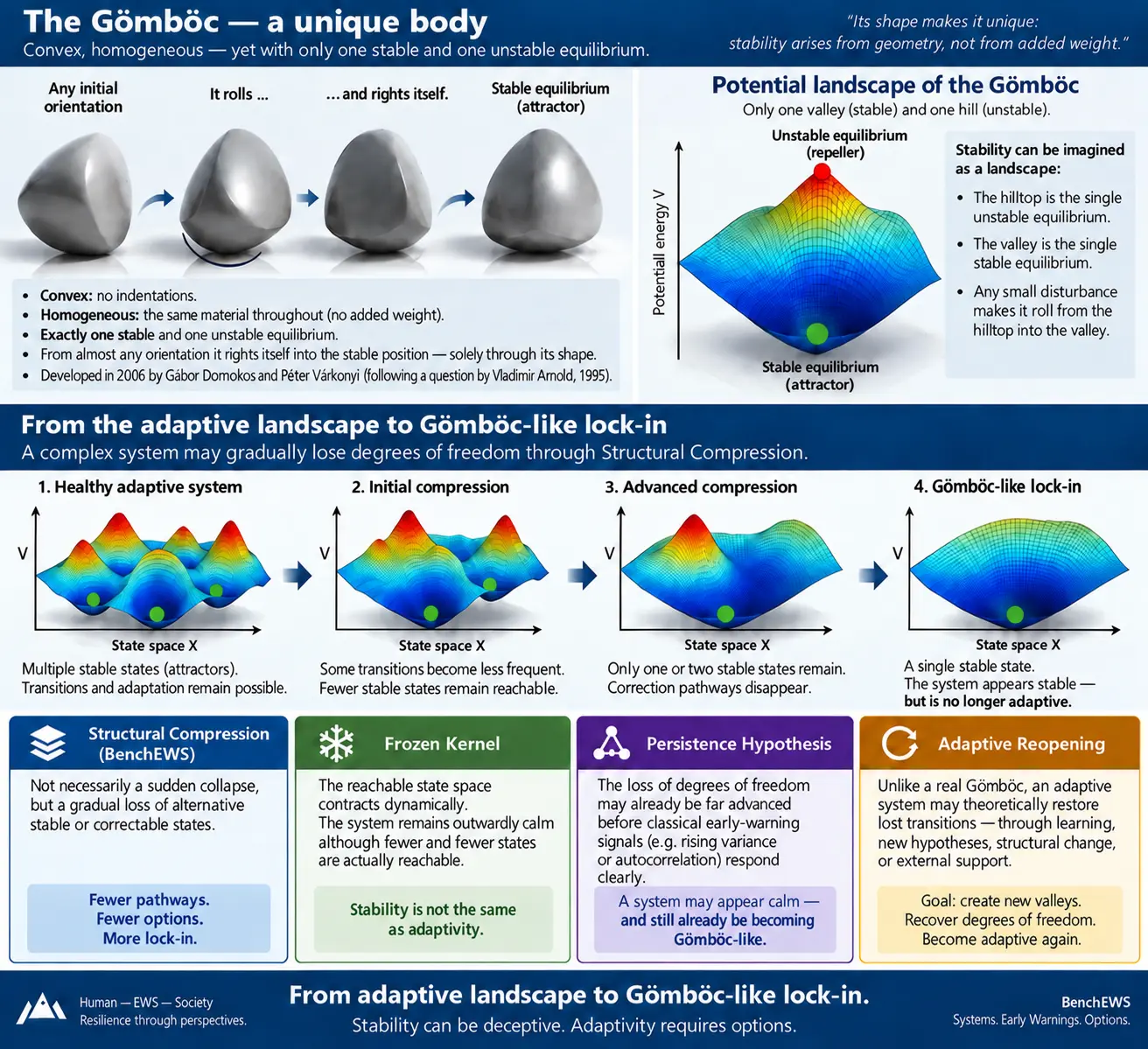
The reachable state space contracts. Fewer alternatives remain dynamically accessible.
The system may appear calm while fewer and fewer states can still be reached.
Loss of degrees of freedom may advance before classical early-warning signals react clearly.
Unlike a real Gömböc, an adaptive system may recover pathways through learning, new hypotheses or structural change.
Stability can be deceptive. Adaptivity requires options.
Reopening is not the reverse movie: after deep compression, restoring response variety can require additional structural change.
Choose your explanation: Simple · Engineering · Science
You started with 12 reachable response options. Strong compression leaves almost only one. When the constraint is removed, only part of the lost variety returns: making options available again does not automatically restore lost adaptability.
12 → 1 → 8 · The outward and return paths differ: a conceptual hysteresis loop. Response Variety is reduced by Structural Compression; the maximum compression reached acts as a memory variable, so Adaptive Reopening is path-dependent.
This demonstrator uses the maximum previously reached compression as an explicit memory variable and applies a reopening penalty to the accessible response space. The value 8 is not an empirical constant or natural law; it is a deliberately chosen visualization of hysteresis/persistence. Repeated cycles are not assumed to cause cumulative degradation.
Conceptual model, not a physical identity. A real Gömböc has exactly one stable and one unstable equilibrium. Here its return geometry is used only as a metaphor for shrinking accessible response space.
05 / EVIDENCE & BOUNDARIES
BenchEWS visibly separates published results, model-derived results, benchmark evidence, empirical evidence, testable hypotheses, and planned research.
06 / Peer-reviewed milestone
The paper on spectral compression of the stationary covariance matrix has been published in AIP Advances. It expands the peer-reviewed mathematical basis of BenchEWS. The AIP paper defines the structural compression index Φ(Σ); broader composite BenchEWS indicators and their software integration are to be treated separately.
DOI 10.1063/5.0337045 ↗07 / Scientific Resonance Observatory
The Observatory documents verified external discovery, citations, substantive reflections, and applications with explicit evidence boundaries.
Open Observatory →08 / PROVENANCE
Dipl.-Ing. Bernd von Mallinckrodt · independent research programme · ORCID 0009-0005-5279-6607
02 / FROM IDEA TO MEASURABLE SIGNAL
When feedback becomes constrained, available alternatives and correction paths may decline. In the model, this corresponds to a loss of effective degrees of freedom.
That loss must leave evidence in data, for example through changing persistence, variance, spectral structure, or related dynamical quantities. Which trace is informative is an empirical question.
BenchEWS and CRTI turn these ideas into testable quantities and counter-conditions. Only then comes the full mathematical specification; a metaphor is not evidence.
In short: metaphor → observable dynamics → measurement → mathematical test. This is the bridge between the Mallinckrodt cycle and early-warning research.
Computational implementation: BenchEWS Studio / MalliSoftware — BenchEWS itself remains the research programme and methodology.