BENCH EWS · OPEN RESEARCH · PLANNED FOR 2027
BenchEWS Duck Lab — Learning to Stay Balanced
Can we detect declining recoverability before a robotic system fails?
Mali, a small robot, is intended as an experimental platform for investigating how stability, control authority and recoverability relate under controlled disturbances and noisy observations.
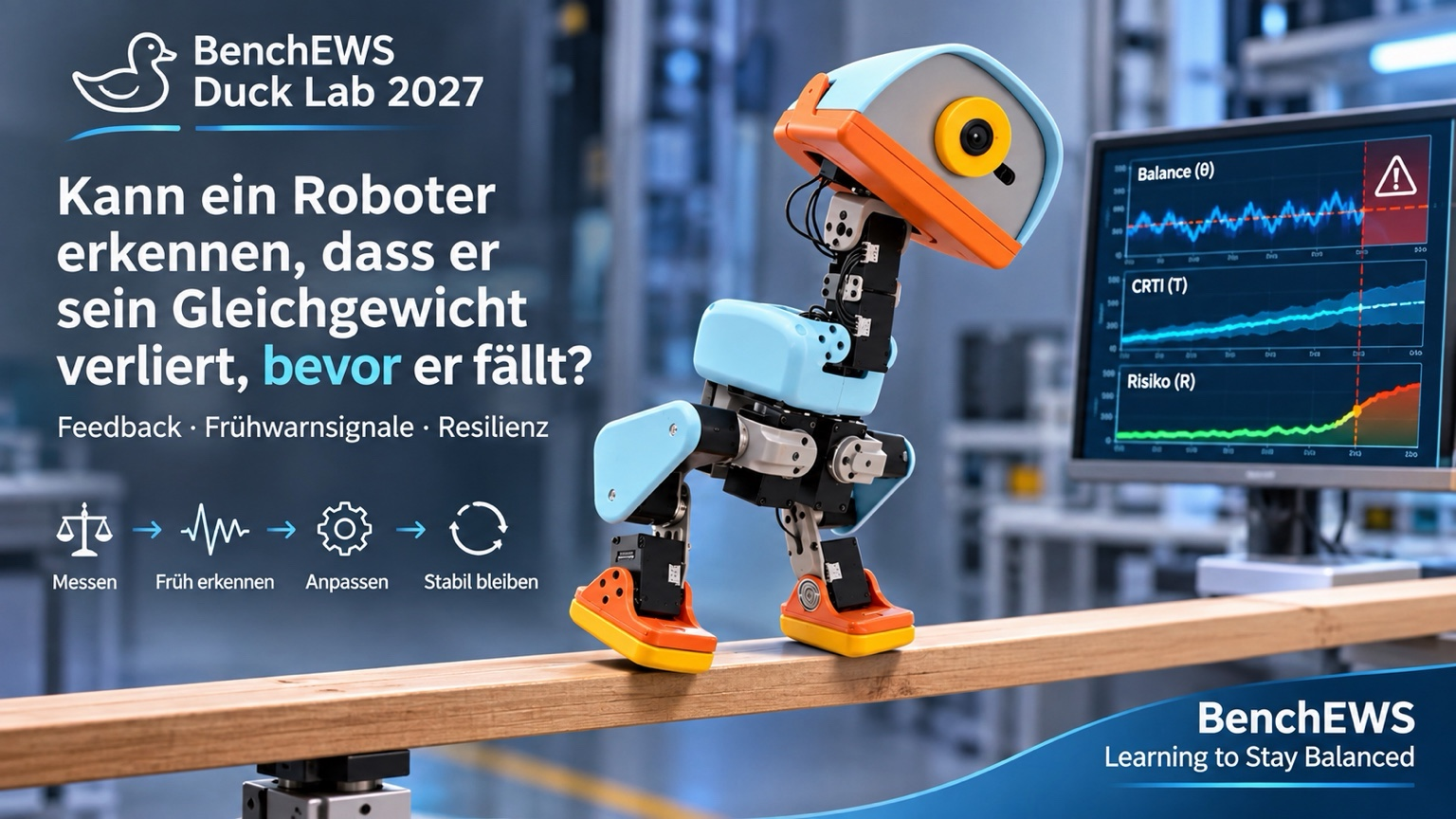
AI-programmable robotics as a research platform
Mali is designed as a programmable robotics platform. AI-assisted Python development can support experiment design, sensor-data analysis and adaptive control experiments. The AI does not itself establish reliable autonomy or early-warning performance: every controller and indicator must be tested against measurable, reproducible outcomes.
Stability is not the same as recoverability.
Classical control theory already distinguishes stability, controllability, stabilizability and reachability. The open question is whether an additional early-warning signal can provide predictive value from limited sensor observations beyond established methods.
Planned experimental comparison
- Controlled, repeatable perturbations and logged sensor time series
- Predefined recoverability outcomes and operational intervention limits
- Baselines including variance, autocorrelation, system identification and control-theoretic estimates where feasible
- Matched data, fair calibration, held-out tests, uncertainty intervals and false-alarm analysis
- Public protocol, code and anonymized measurement data when available
Open invitation to researchers
Researchers in robotics, nonlinear dynamics, system identification, control theory and complex systems are invited to challenge the design, suggest rigorous baselines or discuss independent replication.
What evidence would convince you that an early-warning indicator adds predictive information beyond established control methods?
Status: experimental design in preparation. No robot-based results or incremental predictive benefit established. No institutional collaboration is implied.